
Verlässliche Daten über unsere Lebensgrundlage
Background
Local floristic diversity has massively decreased during the twentieth century in Central Europe even though in the 1990s diversity began increasing again in several regions. However, little is known whether this increase is equally distributed among plant groups with different reproductive traits.
Methods
Our study is based on data of the Swiss Biodiversity Monitoring Program. In this program, plant species occurrence is recorded since 2001 in 450 regularly distributed 1 km 2 study sites. For all 1774 plant species registered in the study, we researched data on flower/pseudanthium type and colour, reproductive system, and groups of flower visitors. We then tested whether temporal changes in species frequency were equally distributed among species with different trait states.
Results
Species richness and functional richness significantly increased in the study sites while functional evenness decreased. The frequency of wind-pollinated species increased more strongly than that of insect-pollinated species. Further, the frequency of species with simple, open insect-pollinated flowers and pseudanthia visited by generalist groups of insects increased slightly more strongly than the frequency of species with complex flowers visited by more specialized groups of flower visitors. Additionally, the frequency of self-compatible species increased significantly more than that of self-incompatible species. Thus, the overall increase in local plant species richness in Switzerland is mostly driven by wind- and generalist insect-pollinated, self-compatible species. In contrast, species with complex flowers, which are essential for specialized groups of flower visitors and species with self-incompatible reproductive systems profited less.
Conclusions
Our study thus emphasizes the need to consider functional traits in the planning and monitoring of conservation activities, and calls for a special focus on plant species with specialized reproductive traits. Keywords: Evenness, Floristic change, Flower colour, Flower type, Functional diversity, Pollination, Reproductive ecology, Self-incompatibility
Abrahamczyk, S., Kessler, M., Roth, T., & Heer, N. (2022). Temporal changes in the Swiss flora: Implications for flower-visiting insects. BMC Ecology and Evolution, 22(1), 109. https://doi.org/10.1186/s12862-022-02061-2
Daten zur zeitlichen Entwicklung der Vielfalt wirbelloser Kleinlebewesen in Fliessgewässern verschiedener Kantone werden den nationalen Datensätzen BDM und NAWA gegenübergestellt. Bis auf wenige Ausnahmen zeigt sich eine auf kantonaler und nationaler Ebene einheitliche Entwicklung: Vor allem die Anzahl pestizidtoleranter Familien und wärmeliebender Arten pro Probenahmestandort nimmt in den letzten Jahrzehnten zu. Mögliche Ursachen dieses Trends sind der Klimawandel sowie eine verbesserte Gewässerqualität.
Gebert, F., Bollmann, K., & Siber, R. (2022). Zeitliche Trends von Makroinvertebraten. Kantonale und nationale Monitoringdaten im Vergleich. Aqua & Gas, 10, 76–82.
Two commensal species of Chironomidae (Diptera, Nematocera) new for the Swiss fauna. − Hosts and habitat of the commensal chironomids Dratnalia potamophylaxi (Fittkau & Lellák, 1971) and Epoicocladius ephemerae (Kieffer, 1924) are briefly presented.
Lods-Crozet, B. (2022). Note brève. Deux Chironomidae (Diptera, Nematocera) commensaux nouveaux pour la Suisse. Entomo Helvetica, 15: 155-157.
Context
The effects of landscape structure on biodiversity may change with the spatial and temporal scale at which landscape structure is measured. Identifying the spatial extent and temporal scale at which the biodiversity-landscape relationship is strongest (i.e., the scale of effect) is important to better understand the effect of landscape structure.
Objectives
The spatial and temporal scale of effect is analyzed to identify whether it differs in ecologically distinct species groups. How species richness-landscape relationship changes with spatial and temporal scales is tested.
Methods
Based on 98 survey plots (1 km2) of vascular plants on the Swiss Plateau, we analyzed the relationships between species richness of different species groups and landscape predictors at different spatial extents (1 km2, 4 km2, 16 km2, 36 km2) and time periods (past landscapes—1985, 1997, 2009 and the current landscape 2018).
Results
The spatial scale of effect was 1 km for most species groups, while the temporal scale of effect differed among species groups. The strength of the species richness-landscape relationship generally decreased with increased spatial extents, while it changed little across temporal scales.
Conclusions
Although our study only considered changes in landscape structure over the last c. 30 years, ecologically distinct species groups revealed differences in the temporal scale of effect including a rapid response of neophytes linked to ongoing biological invasions. However, the variation in the species richness-landscape relationship was greater when changing spatial extent than time. We highlight that studying the relationship between landscape structure and biodiversity should consider not only space but also time, and different responses of ecologically distinct species groups.
Pan, Y., Hersperger, A. M., Kienast, F., Liao, Z., Ge, G., & Nobis, M. P. (2022). Spatial and temporal scales of landscape structure affect the biodiversity-landscape relationship across ecologically distinct species groups. Landscape Ecology. https://doi.org/10.1007/s10980-022-01477-x
Bryophytes provide key ecosystem services at the global scale such as carbon storage and primary production in resource limited habitats, but compared to vascular plants knowledge on how these organisms face recent climate warming is fragmentary. This is particularly critical because bryophytes differ fundamentally from vascular plants in their ecophysiological and biological characteristics, so that community alterations most likely have different dynamics.
In a comparative approach, we analysed thermophilisation of bryophyte and vascular plant communities in 1146 permanent plots distributed along an elevational gradient of nearly 3.000 m in Switzerland (Central Europe) that were visited in 5-years intervals between 2001 and 2021. We estimated thermophilisation from changes in unweighted mean temperature indicator values of species, compared it to expected thermophilisation rates given the shift of isotherms and addressed differences between the two lineages, major land use types (managed grasslands, forests, unmanaged open areas), life strategy types (long- and short-lived species) and in elevation.
Thermophilisation of bryophyte communities was on average 2.1 times higher than of vascular plant communities and at high elevations it approximated the expected rate given the shift of isotherms. Thermophilisation of both, bryophyte and vascular plant communities was not driven by a loss of cryophilic species but by an increase in thermophilic and mesophilic species, indicating an in-filling process. Furthermore, our data show that thermophilisation is higher in managed grasslands than in forests.
We suggest that the higher responsiveness of bryophytes compared to vascular plants depends on their poikilohydry and dispersal capacity and that lower thermophilisation of forests communities is related to the buffering effect of microclimatic conditions in the interior of forests. Our study emphasises the heterogeneity of climate warming effects on plants because response dynamics differ between taxonomic groups as well as between land use types and along elevational gradients.
Kiebacher, T., Meier, M., Kipfer, T., & Roth, T. (2023). Thermophilisation of communities differs between land plant lineages, land use types and elevation. Scientific Reports, 13(1), 11395. https://doi.org/10.1038/s41598-023-38195-6
Sonderheft Hotspot
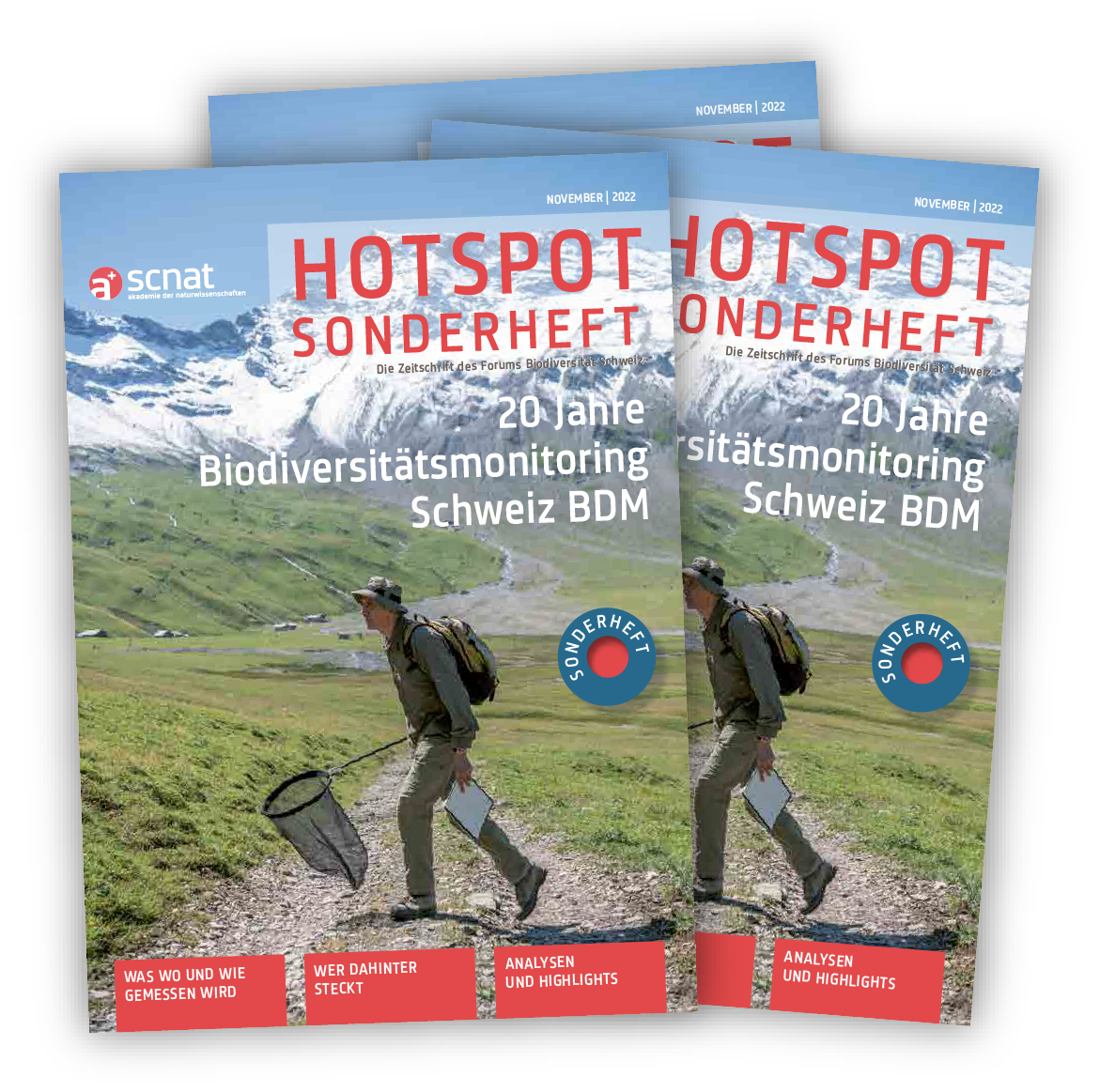
Das Hotspot Sonderheft zu 20 Jahren BDM zeigt, wer hinter den Daten steckt und beleuchtet aktuelle Entwicklungen der Biodiversität.
Publikationen
Sammlung aller veröffentlichten wissenschaftlichen Publikationen mit Daten des BDM: